 NodeCrypto
Ready-made workflows
Open any workflow directly in the NodeCrypto web app or download the portable .ncw file. Every workflow in this collection is verified against an official RFC/NIST/KISA test vector or cross-checked against an independent reference implementation, with full architectural walkthroughs and intermediate byte specifications.
-
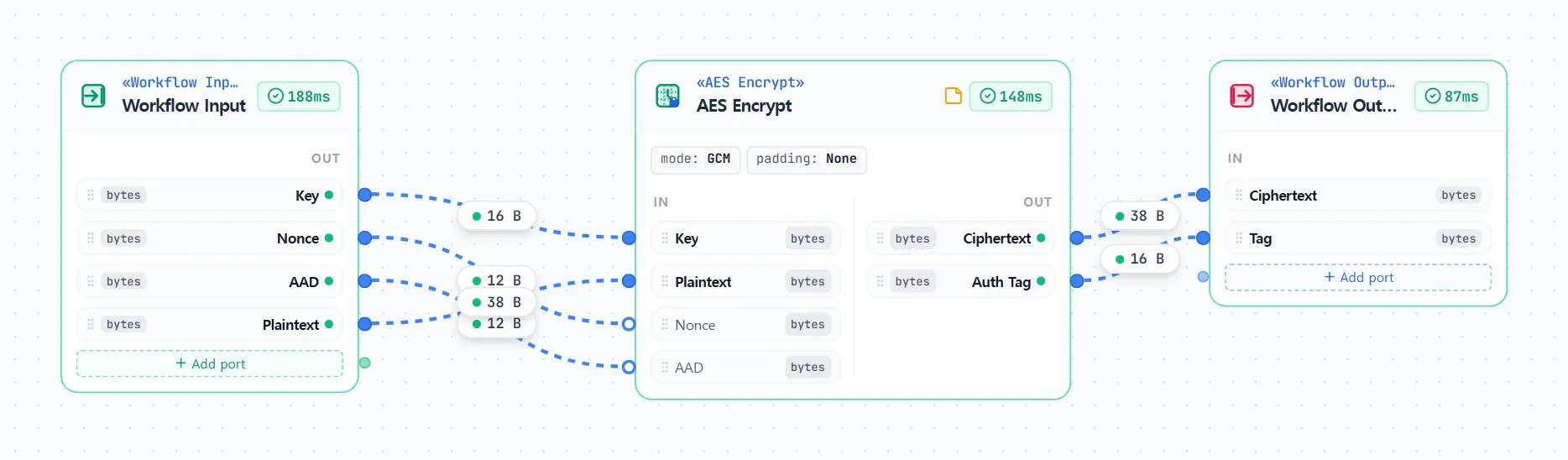 Symmetric · AEADRFC 7714 §16.1.1
AES-GCM encryption
AES-128-GCM authenticated encryption with a 96-bit nonce and associated data (AAD) for an SRTP packet. Outputs both ciphertext and the 128-bit authentication tag.
3 nodes ·symmetric-aes-encryptOpen guide → -
Symmetric · Port NamingRFC 7714 §16.1.1
AES-GCM with port names
The same AES-128-GCM SRTP authenticated encryption pipeline with semantic protocol role names (
Packet Payload,Encrypted Payload) assigned to fixed ports.3 nodes · Custom port labelsOpen guide → -
Symmetric · KISA StandardRFC 4269 App. B.4
SEED-128 block encryption
Encrypts a single 128-bit block with the Korean national standard block cipher SEED in ECB mode without padding, verified against KISA and RFC 4269 test vectors.
3 nodes ·symmetric-seed-encryptOpen guide → -
Symmetric · Value RegistryFIPS 197 App. C.1
AES with variables
Implements the official FIPS 197 Appendix C.1 AES-128 block encryption test vector where the key and plaintext are dynamically resolved from named Value Registry variables (
$example.aes.*).3 nodes ·$varbindingsOpen guide → -
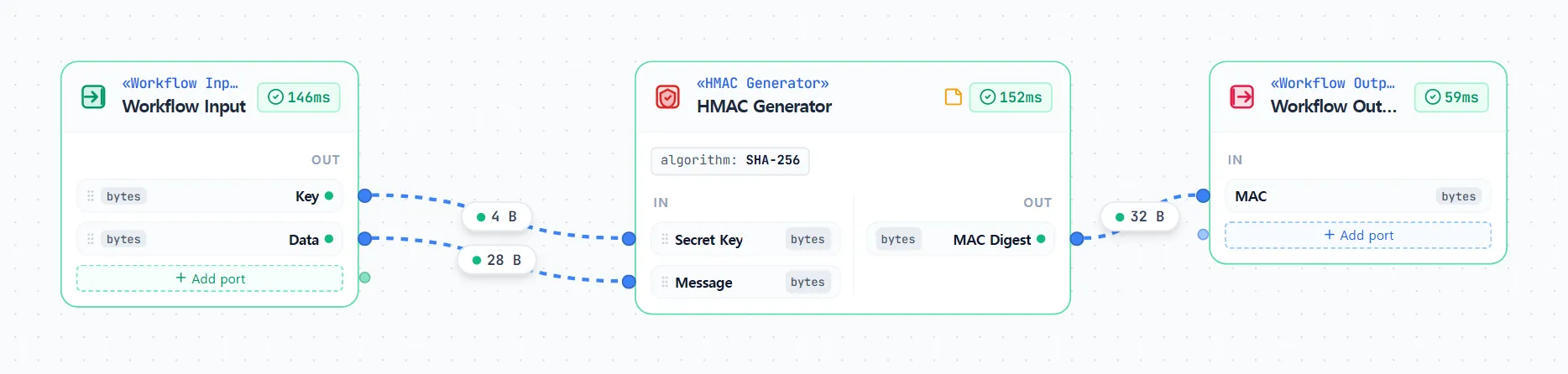 MAC · Keyed HashRFC 4231 §4.3
HMAC-SHA-256
Computes a 32-byte keyed-hash message authentication code over an ASCII message under a short secret key ("Jefe"), checked against RFC 4231 Test Case 2.
3 nodes ·mac-hmacOpen guide → -
MAC · Block CipherRFC 4493 §4
AES-CMAC
Computes the Cipher-based Message Authentication Code (AES-128-CMAC) of a multi-block 40-byte message using subkey mask $K_2$, verified against RFC 4493 Example 3.
3 nodes ·mac-cmacOpen guide → -
MAC · Built-in ScriptRFC 4493 §2.3
CMAC subkey generation
Derives the RFC 4493 CMAC subkeys $K_1$ and $K_2$ from an AES-128 key by encrypting an all-zero block $0^{128}$ and executing Galois field $\mathrm{GF}(2^{128})$ doubling in a Script node.
4 nodes ·utility-scriptOpen guide → -
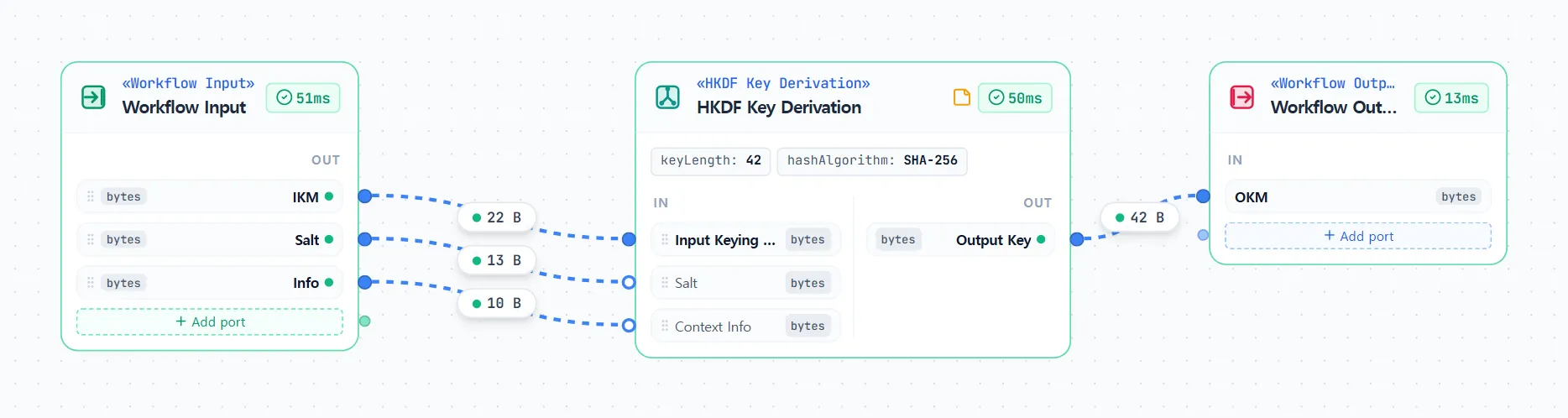 Key DerivationRFC 5869 §A.1
HKDF-SHA-256
HMAC-based Extract-and-Expand key derivation (RFC 5869) generating 42 bytes of output keying material (OKM) from raw input keying material, salt, and context info.
3 nodes ·kdf-hkdfOpen guide → -
Key Derivation · PasswordRFC 7914 §11
PBKDF2-HMAC-SHA-256
Password-based key derivation with HMAC-SHA-256 stretching a password and salt into a 64-byte (512-bit) derived key across two internal blocks, verified against RFC 7914.
3 nodes ·kdf-pbkdf2Open guide → -
Asymmetric · ECDHRFC 7748 §6.1
X25519 key agreement
Computes the 32-byte Montgomery curve Curve25519 shared secret from one party's clamped scalar private key and the peer's u-coordinate public key per RFC 7748.
3 nodes ·asymmetric-x25519-ecdhOpen guide → -
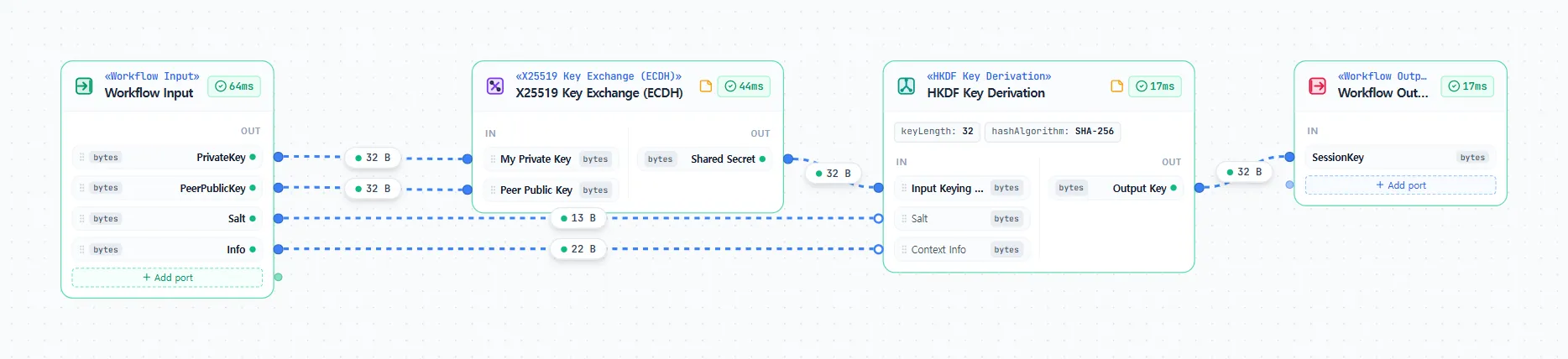 Asymmetric + KDFRFC 7748 + 5869
X25519 + HKDF
Chains X25519 elliptic-curve Diffie-Hellman key agreement directly into HKDF-SHA-256 with a salt and domain-separation context string to derive a uniform 32-byte session key.
4 nodes · ECDH → HKDFOpen guide → -
Asymmetric + KDF · Port NamingRFC 7748 + 5869
X25519 + HKDF with port names
The same X25519 + HKDF-SHA-256 session-key derivation pipeline with protocol-specific port names (
Local Private Key,Raw Shared Secret,Session Key) on both nodes.4 nodes · Custom port labelsOpen guide → -
 Signature · EdDSARFC 8032 §7.1
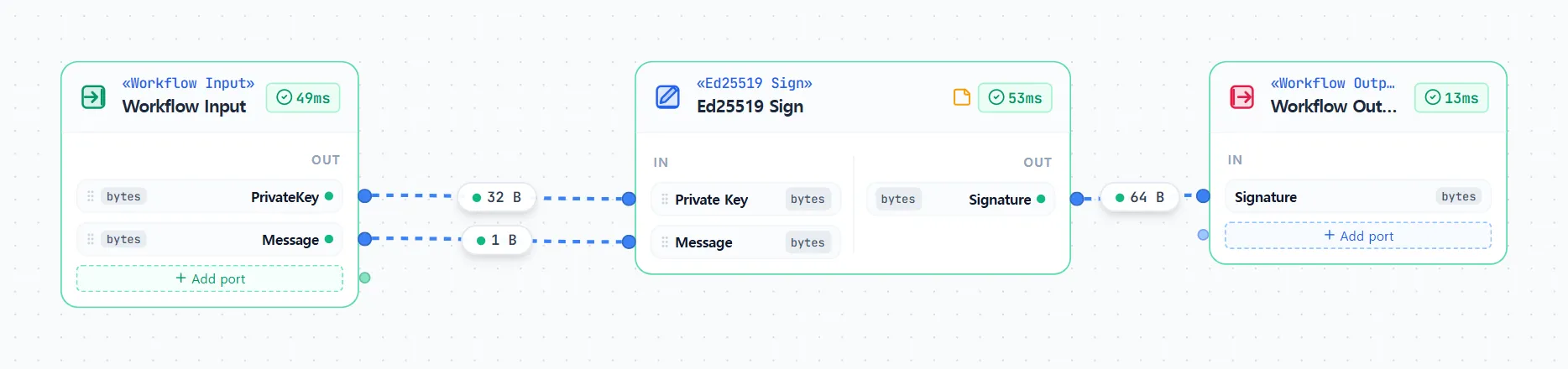
Ed25519 signature
Computes a deterministic 64-byte Ed25519 digital signature over a 1-byte message using a 32-byte secret key seed, checked against RFC 8032 §7.1 Test 2.
3 nodes ·asymmetric-ed25519-signOpen guide → -
Post-Quantum · KEMFIPS 203 (ML-KEM-768)
ML-KEM-768 decapsulation
Decapsulates a 1,088-byte lattice KEM ciphertext using a full 2,400-byte ML-KEM-768 decapsulation key with FO implicit rejection verification, checked against C2SP CCTV vectors.
3 nodes ·pqc-mlkem-decapsOpen guide → -
Post-Quantum · KEMFIPS 203 Round Trip
ML-KEM-768 round trip
Complete FIPS 203 ML-KEM-768 key generation, encapsulation, and decapsulation in a single graph, verifying with a Value Comparator that both parties derive the identical 32-byte shared secret.
6 nodes · KeyGen → Encaps → DecapsOpen guide → -
 Protocol DemoNIST P-256 KeyGen
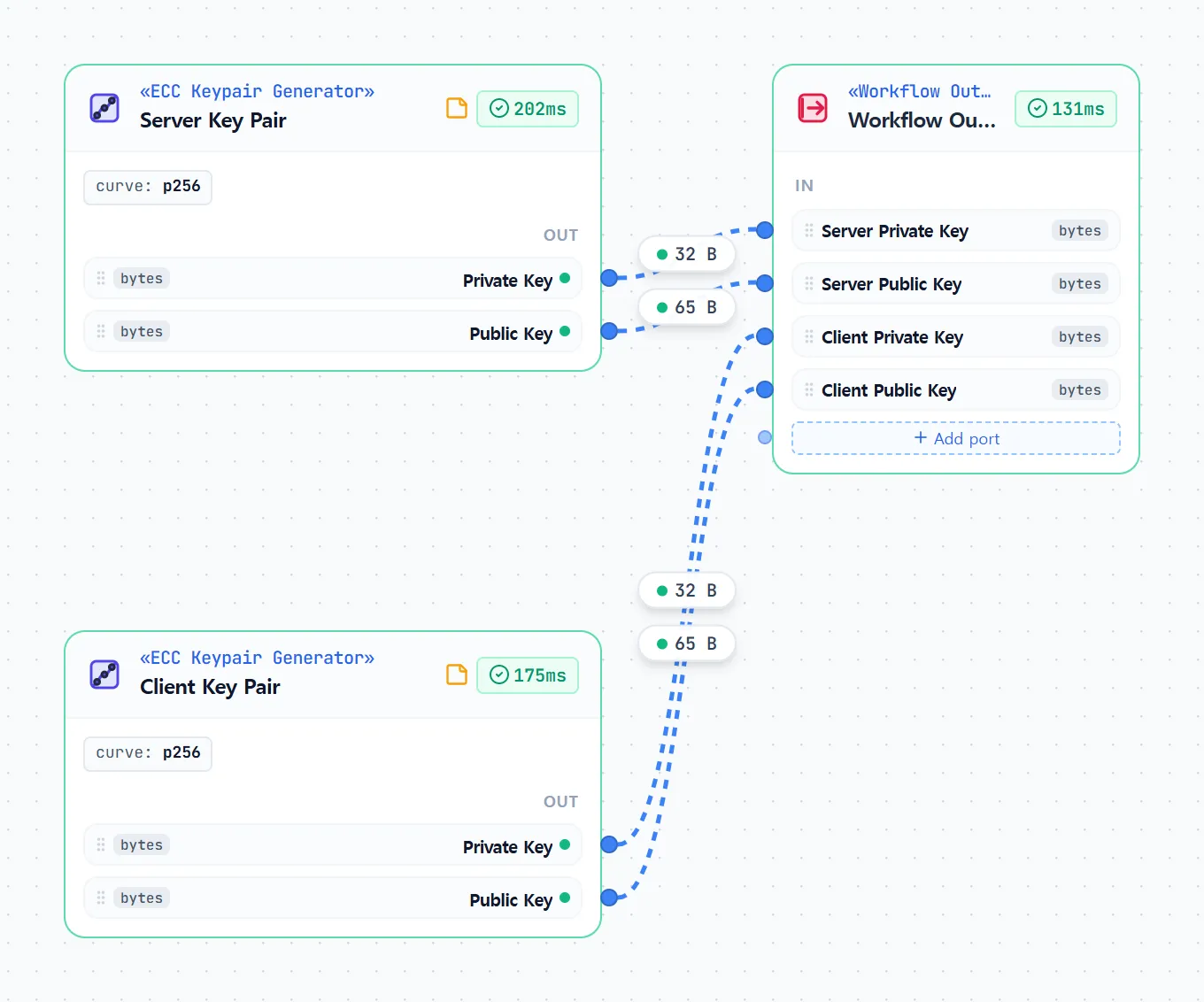
DID Auth: key pairs
Generates two fresh NIST P-256 (secp256r1) key pairs—one for the server and one for the client—used across the DID Auth challenge-response protocol suite.
3 nodes ·asymmetric-ecc-keygenOpen guide → -
 Protocol DemoECDH + SHA-256 + AES-CBC
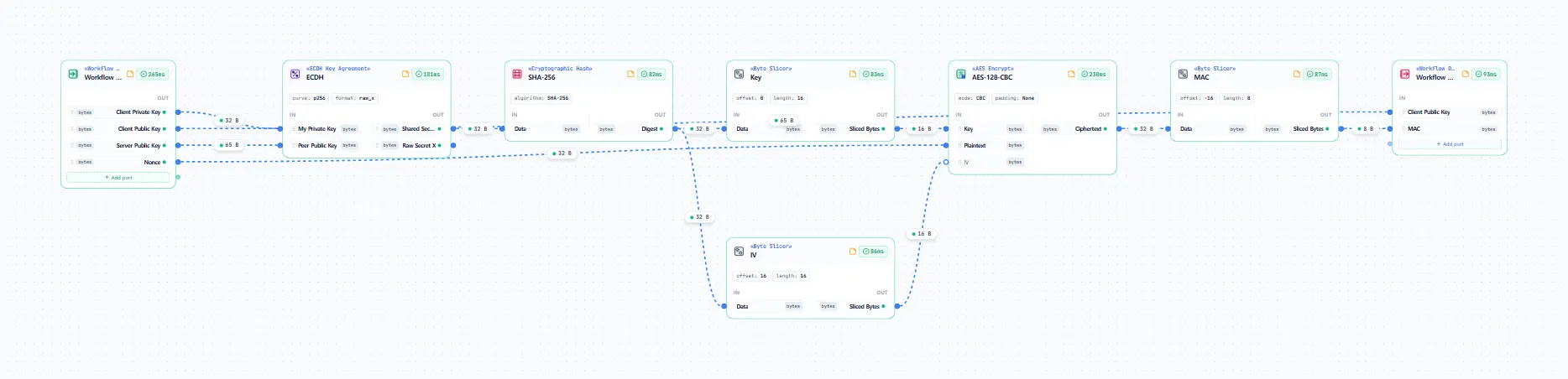
DID Auth: client
Client side of an ECDH challenge-response authentication flow: derives an AES-128 key and IV from SHA-256(ECDH), encrypts the server's 32-byte nonce, and slices an 8-byte response MAC.
8 nodes · Client authentication pipelineOpen guide → -
 Protocol DemoECDH + MAC Verification
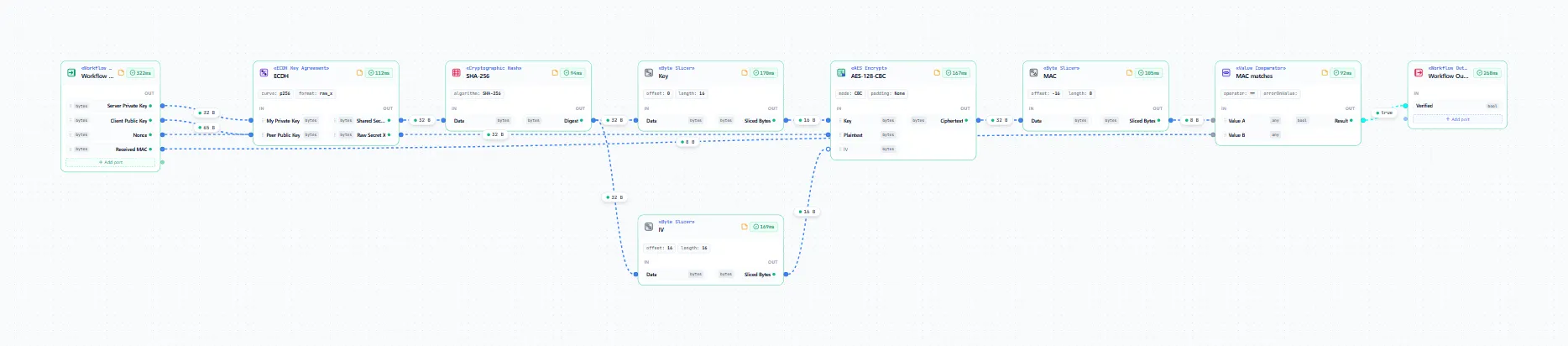
DID Auth: server
Server side of the DID Auth challenge-response flow: independently derives the shared secret from its private key and the client's public key, recomputes the expected 8-byte MAC, and verifies equality.
9 nodes · Server verification pipelineOpen guide → -
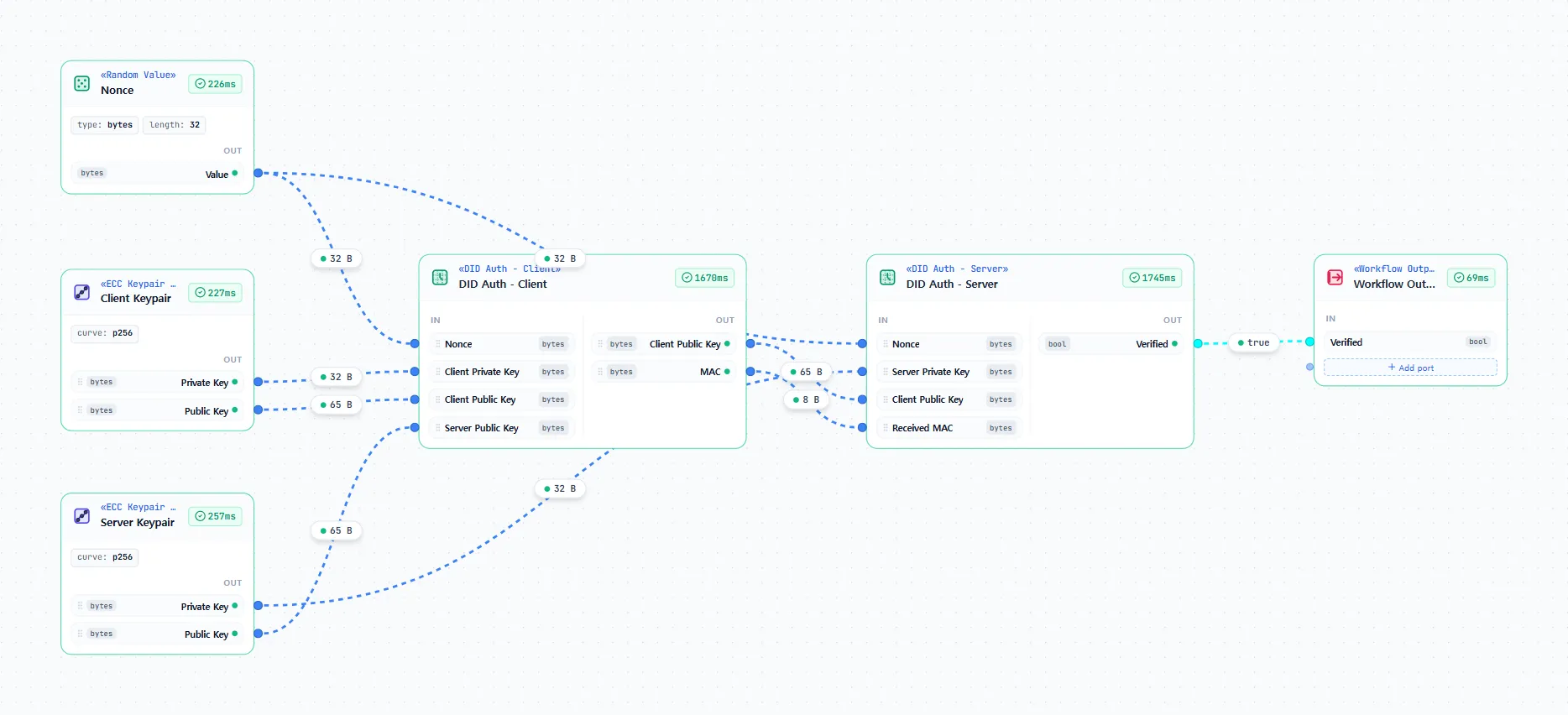 Protocol DemoCustom Nodes · End-to-End
DID Auth demo
End-to-end protocol simulation packaging the Client and Server workflows as embedded custom nodes and wiring them together with fresh P-256 key pairs and a random 32-byte challenge nonce on every run.
6 nodes · Embedded custom nodesOpen guide →